Banking Growth Strategy or Growth Activities?
Categories:
Community banks and credit unions have never worked harder at growth — or had less to show for it. The problem isn’t effort. It’s fragmentation: a splintering consumer relationship met with a splintered response.
Ask a community bank or credit union leadership team what they’re doing about growth, and you’ll get a long list. A CD rate promotion. A digital account opening upgrade. A new mover mail program. A push on debit activation. A fee study. A core contract renegotiation.
Every item on that list is defensible. Almost none of them are connected.
That’s the quiet problem beneath the growth numbers, and the numbers tell a hard story. NCUA data from late 2025 showed median credit union membership declining, with more than half of federally insured credit unions reporting fewer members than the year before. In Cornerstone Advisors’ What’s Going On in Banking 2026, new consumer growth ranks as the number one strategic priority, and deposit gathering sits atop the worry list for 69% of credit union executives and 51% of bank executives. Everyone agrees growth is the priority. Far fewer institutions can articulate a theory of how their growth efforts work together.
The diagnosis most leadership teams reach for is competition: megabanks, fintechs, neobanks. That’s real, but it’s incomplete. The deeper challenge is fragmentation, and it’s happening on two levels at once.
Fragmentation #1: Your Account Holder’s Financial Life
The account holder relationship is no longer a single relationship. MX research finds the average consumer holds five to seven financial accounts across different providers, and 77% of U.S. consumers now believe a person can have more than one “primary” financial relationship. Nearly a quarter open a new financial account at least once a year.
Read that carefully, because the threat isn’t that consumers are leaving. It’s that they’re fractionalizing. The direct deposit lands at one institution. The high-yield savings sits at another. The credit card rewards program belongs to a third. A fintech app handles person-to-person payments. Your institution may still hold the checking account and lose the relationship one slice at a time.
There’s an important nuance here that should keep us honest: some research suggests consumers are consolidating the number of providers they use. What’s fragmenting isn’t necessarily the account count. It’s primacy; the assumption that the checking account automatically anchors the rest of the financial relationship. That assumption built the community banking business model. It no longer holds by default. It must be won, deliberately, account by account.
And primacy has a center of gravity: the paycheck. Whoever owns the direct deposit owns everything downstream: the daily balance, the debit activity, the data, and the first look at every future borrowing need. That’s the real prize in checking acquisition, and it’s why counting openings tells you almost nothing about whether you’re winning.
The good news hiding in this data: most of those competing accounts are shallow. Industry analysis of fintech checking accounts consistently finds low balances and inconsistent transaction activity — supplementary accounts, not financial hubs. The primary relationship is still very much winnable, but only by institutions that compete for it on purpose.
Fragmentation #2: Your Own Growth Strategy
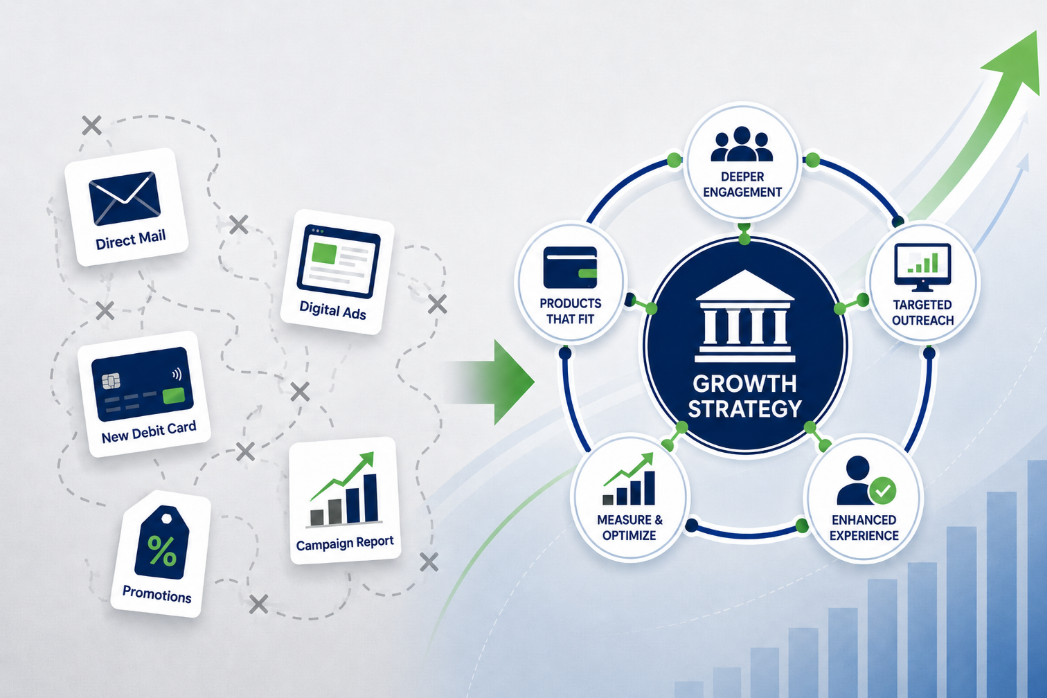
Here’s the uncomfortable mirror: most institutions respond to a fragmenting consumer with an equally fragmented strategy.
In our work with community financial institutions, it’s common to find seven or more disconnected vendors and platforms, each touching growth on its own terms: one for digital ads, one for direct mail, one for onboarding, one for email, each with its own dashboard and its own definition of success.
Acquisition lives in one silo. Engagement and activation live in another. Non-interest income lives across several. Vendor costs live in yet another. The acquisition team celebrates account openings. The retail team inherits accounts that never activate. Finance watches as non-interest income erodes. Operations renews contracts priced for the institution as it existed five years ago.
None of these teams is failing. The connections between them are failing. An account acquired that never engages is a cost. Engagement without a path to responsible revenue doesn’t fund the next campaign. Savings identified in vendor contracts but never redeployed into growth just pad a single year’s efficiency ratio. And marketing without attribution — without visibility from first impression to funded, active account — isn’t a strategy; it’s spend. Data without activation is just reporting.
This is the pattern we’ve organized our entire company around at ADVANTAGE. We think of institutional growth as one system with four engines:
- acquire the right relationships,
- engage them so they activate and deepen,
- monetize them responsibly,
- and optimize the cost structure beneath it all.
Each engine can run on its own. But the compounding only happens when they connect — when acquisition feeds engagement, engagement supports responsible revenue, and optimization frees the dollars that fund more acquisition. Most institutions try to fix these problems in isolation. The institutions that win fix the system that connects them.
Why Acquisition is the Keystone
If the four engines form a system, acquisition is where the system starts, because if the base doesn’t grow, nothing downstream compounds. Engagement programs can’t deepen relationships that don’t exist. Non-interest income strategies can’t monetize a shrinking account base. Cost optimization can extend the runway, but it can’t generate altitude.
That makes the quality of acquisition the highest-leverage decision most institutions face. And it’s exactly where fragmented thinking does the most damage, in four recognizable ways:
Competing too late. Most acquisition marketing enters the consumer’s journey at the worst possible moment: after they’ve already started shopping. By the time someone searches “best checking account near me,” they’re comparing rates and bonuses in the most contested, most expensive slice of the market, and Cornerstone’s research suggests many consumers search for a product before they ever consider a specific brand. The institutions that win primacy are the ones reaching households before active consideration begins, using life-event and behavioral signals, like an upcoming move or a change in financial circumstances, to show up when the relationship is actually in motion rather than bidding against everyone else once it’s in play. Deposit growth isn’t only a marketing problem. It’s a timing problem.
Buying openings instead of relationships. BAI research puts the average cash incentive for a new checking account at $277, and rate-shoppers who churn after the bonus clears can push the true cost far higher. There’s a name for this pattern: share-shifting. Incentive-led campaigns mostly move bonus-seekers from one institution to another, at rising cost, without creating durable relationships anywhere. An acquisition strategy measured in openings will happily buy accounts that never become relationships. Measured in primacy — direct deposit, debit activity, digital engagement — the same budget produces a very different portfolio.
Targeting everyone, reaching no one. Fragmented acquisition relies on geography, sending the same offer to everyone within the branch footprint. Data-driven acquisition treats the market as households with predictable likelihoods of becoming primary relationships and concentrates spend where that likelihood is highest. This especially matters for community institutions, because the instinct is to lean on community trust and local identity to carry the message. Trust matters, but it doesn’t convert on its own: emotional connection doesn’t equal primary relationships, and deposits follow behavior, not branding. In a market where the marginal acquisition dollar is contested by institutions a thousand times your size, precision isn’t a luxury. It’s the only viable position.
Treating the account opening as the finish line. Digital account opening is growing fast. Cornerstone and Alkami research found digital openings climbed to roughly 21% of checking openings in 2024, up from 16% the year before. That’s progress, but a digitally opened account is even easier to abandon than a branch-opened one, and our own analysis of new-account behavior shows a large share of new accounts going dormant within the first 90 days. Those ninety days decide whether an opening becomes a relationship; whether the direct deposit moves, the debit card activates, the app gets downloaded. If acquisition and engagement don’t share a plan for that window, the acquisition budget is quietly subsidizing attrition.
The Systems Question to Ask Your Team
Here’s a simple diagnostic. Ask your leadership team: When we acquire a new checking account, who owns what happens next — and how would we know if it worked?
If the answer involves three departments, two vendors, and no shared metric, you don’t have a growth strategy. You have a collection of growth activities. The distinction matters because fragmented activity produces linear results at best, while connected systems compound, each engine making the next one cheaper and more effective.
Community banks and credit unions still hold the assets that matter most in this fight: local trust, real relationships, and the ability to move faster than institutions a hundred times their size. The consumer data says the primary relationship is still up for grabs, with many of the competing accounts in your account holders’ lives remaining shallow, transactional, and undefended.
But primacy won’t be won by accident, and it won’t be won one disconnected tactic at a time. It will be won by institutions that decide growth is a system and start running it like one.
Learn how a structured checking acquisition program can help grow deposits and strengthen primary relationships.
Contact ADVANTAGE to start the conversation.
ADVANTAGE partners with community banks and credit unions to drive sustainable growth and operational efficiency. With more than four decades of industry experience, ADVANTAGE delivers data-driven solutions that help financial institutions expand market share, strengthen non-interest income, and improve technology utilization.

Tags: