You Can’t Deposit Community Spirit
Categories:
Chime doesn’t know a single customer’s name….they’re winning anyway.
Let’s get one thing straight: community matters. The relationships your institution has built, the small businesses you’ve funded, the families you’ve helped buy their first homes—that is real, it is meaningful, and it is genuinely differentiated from anything a fintech will ever offer.
But here’s the hard truth that the data keeps delivering: It is not enough anymore.
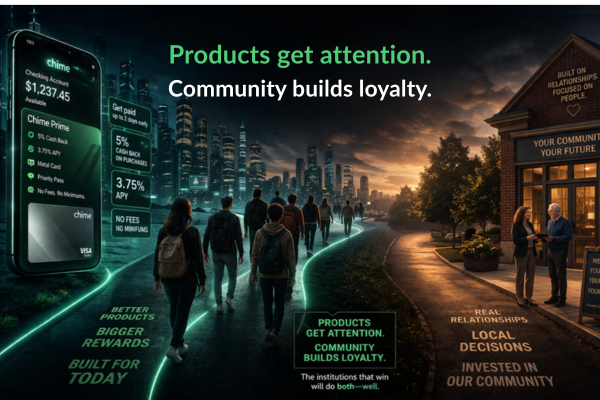
Chime recently launched Chime Prime, featuring high-yield APY, cash back, premium card features, and no-fee structures. According to J.D. Power, they are already opening more checking accounts than any other financial institution in America—without a single branch, without a single loan officer coaching the local Little League team, and without a single community reinvestment dollar.
They are winning on product. Full stop.
And until community banks and credit unions are willing to have an honest conversation about that, the market share erosion will continue—quietly, steadily, and one direct deposit at a time.
The Assumption That’s Costing You Accounts
There is a deeply held belief in community banking that goes something like this: if we serve our community well, take care of our members, and stay true to our roots, growth will follow.
It’s a beautiful belief. It’s also increasingly disconnected from how consumers, particularly younger consumers, actually make banking decisions.
Here’s what the research consistently shows: consumers today assume a baseline level of trust and competence across all financial institutions the same way they assume their doctor is qualified or their grocery store doesn’t sell rotten food. Trust is no longer a differentiator—it’s table stakes.
The decision comes down to a simpler, more transactional question:
What does this account actually do for me?
That is the question Chime answers brilliantly. That is the question too many community FIs are still not answering at all, because they’re too busy talking about who they are instead of what they offer.
So while community spirit is a wonderful reason to stay, it is rarely the reason someone walks in the door.
When Community Becomes a Differentiator (and When It Doesn’t)
Here is where we want to be precise, because this is not an argument against community values. It is an argument for sequencing.
When all other things are equal, when your product is competitive, your digital experience is frictionless, your rates are in the conversation, your community story becomes a genuine differentiator. It becomes the tiebreaker. It becomes the reason someone who could go anywhere chooses you. That is a powerful position to be in.
But all other things are not equal right now. And pretending they are is not a community-first strategy. It is a growth-last strategy.
The institutions that will thrive in the next decade are the ones that earn the right to tell their community story by first building the product that gets people in the door.
Instead of: “We’ve been part of this community for over 75 years.”
Say: “Here’s exactly what you earn when you bank with us.”
Heritage is not a product benefit. Nobody opens a checking account because of longevity. They open one because it pays them something, saves them money, or makes their financial life easier.
The institutions winning new accounts today lead with tangible value, a competitive APY, cash back on purchases, early direct deposit, and no hidden fees. They put the number in the headline. They make the value impossible to ignore.
The shift in practice: Instead of a homepage hero that leads with your founding story, lead with your best rate or your strongest account feature. Save the story for when they’re already interested. A prospective account holder needs a reason to stop scrolling before they’ll ever care about your history.
Instead of: “We know you by name.”
Say: “We make the things that actually stress you out easier.”
Personal service is a genuine strength. But “we know you by name” signals to a digital-first consumer that your institution requires human interaction to function. For a generation that would rather resolve a dispute through an app than call a phone number, that is not reassuring. It is a friction warning.
The better angle is empathy around real financial pain points, overdraft anxiety, paycheck timing, unexpected expenses, and then demonstrating specifically how you solve them. Meet the consumer where their stress actually lives.
The shift in practice: “Get paid up to two days early” or “No hidden fees, ever” speaks directly to the financial anxiety that millions of Americans carry into every banking interaction. That is the conversation worth leading with. The personal touch becomes the differentiator once they’re already a member.
Instead of: “We reinvest in the local economy.”
Say: “When you need a loan, you’re talking to a decision-maker—not an algorithm.”
The reinvestment message is abstract. Consumers don’t feel it when they’re deciding where to open a checking account. But the loan decision message? That is concrete. It is true—and it is something fintechs struggle to replicate.
Community FIs have a genuine structural advantage in lending, local underwriting, relationship-based decisions, and flexibility that a national algorithm will never have. But that advantage disappears entirely if it’s buried in ESG language that sounds like every other institution’s annual report.
The shift in practice: “We’ve helped hundreds of local small businesses get funding after being turned down by the big banks” is a story. It’s specific, it’s emotional, and it draws a clear line between you and your competitors. Lead with the outcome, not the virtue.
Instead of: “We’re local and we care.”
Say: “Here’s what we offer that the big banks and fintechs simply don’t.”
“Local and caring” is what every community FI says. When everyone says the same thing, no one is saying anything. The institutions breaking through right now are the ones willing to draw a sharp, specific contrast, not by attacking competitors, but by clearly articulating a better offer.
This requires having something differentiated to point to. Which is precisely why product has to come first. If your checking account doesn’t have competitive rewards, a strong APY, and a genuinely frictionless digital experience, then “local and caring” is the entire value proposition, and today, that is not a growth strategy.
The shift in practice: “Unlike the big banks, we don’t charge you to access your own money. Unlike the fintechs, we’re actually here when something goes wrong.” Short, direct, and comparative without being combative. That is a message that lands.
The Posture Shift: From Waiting to Winning
The most important change isn’t about messaging. It’s about posture.
For decades, community financial institutions have grown from a position of patience, trusting that local loyalty, word of mouth, and community presence would organically drive new relationships. That model worked when the competitive landscape was other community banks and regional players who were all operating from the same playbook.
That landscape no longer exists.
Chime is not waiting. They are spending aggressively on digital acquisition, engineering products that generate organic buzz, and systematically capturing the next generation of primary banking relationships before community institutions ever get the chance to make their case. They don’t need to know anyone’s name. They just need to be better at the moment of decision.
The community banks and credit unions that will grow in this environment are the ones that go on offense. That means building checking products compelling enough to compete for new account holders on product merit alone. It means targeting new movers, young professionals, and underserved segments with specific and irresistible offers. It means showing up digitally, proactively, and persistently, rather than waiting for community loyalty to do the work.
And then, once the product earns the relationship, it means letting your community story do what it was always meant to do: deepen the connection, build the loyalty, and become the reason they never leave.
Community first is a value system. It should never be a marketing strategy.
Build the product. Earn the relationship. Then tell the story.
Learn how a structured checking acquisition program can help grow deposits and strengthen primary relationships.
Contact ADVANTAGE to start the conversation.
About ADVANTAGE
ADVANTAGE partners with community banks and credit unions to drive sustainable growth and operational efficiency. With more than four decades of industry experience, ADVANTAGE delivers data-driven solutions that help financial institutions expand market share, strengthen non-interest income, and improve technology utilization.
If you’re evaluating how your acquisition approach supports long-term relationship value, a strategic conversation can help clarify next steps. Explore Smarter Account Acquisition →

Tags: